R.E.A.L. Eye Model Laser System
A reusable 3D-printed model eye system for teaching retinal laser photocoagulation.
EXPLORE THE PROJECT
The R.E.A.L. (Reusable Eye for Application of Laser) Eye Model was created to improve the way trainees are taught retinal laser photocoagulation. Trainees practice retinal laser photocoagulation in a realistic, reusable, and low-risk setting. Trainees can practice:
Slit-lamp laser training
Indirect laser training
Peripheral laser practice
Scleral depression simulation
PROJECT GOALS
HOW IT WORKS
A thermochromic retinal surface provides visible, reversible laser feedback.
The R.E.A.L. Eye Model uses a 3D-printed model eye with an internal retinal surface coated with thermochromic material. When treated with a clinical ophthalmic laser, the simulated retina visibly changes color at the site of laser application, allowing the trainee to see where energy was delivered.
This creates an immediate visual feedback system for evaluating:
Laser spot placement
Treatment pattern
Spacing between laser burns
Coverage of peripheral retina
Ability to maintain visualization and focus during laser delivery
Because the color change is reversible, the same model can be used repeatedly for practice sessions.
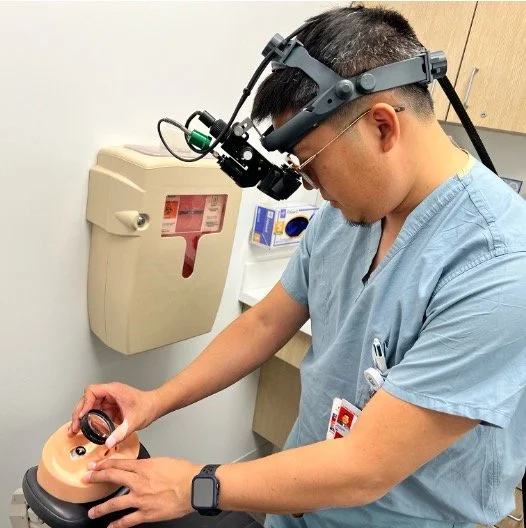
The system is compatible with both slit-lamp based laser delivery and indirect ophthalmoscopic laser systems, allowing trainees to practice techniques used in real clinical care.
HOW ITS BUILT
A modular 3D-printed model eye system with interchangeable optics and training configurations.
The R.E.A.L. Eye Model system is built around a modular 3D-printed eye that can be placed into a larger orbital holder. The system includes a model eye shell, an optical component, and a simulated retinal insert.
Different model configurations were created to simulate varying optical conditions, including pediatric, emmetropic, and myopic eyes. These variations allow trainees to experience differences in retinal visualization and laser delivery.
The model incorporates:
A 3D-printed eye shell
Interchangeable optical components
A thermochromic retinal surface
A base/orbit holder for stabilization
A gimbal-style support system for controlled eye positioning
A scleral-depressable configuration for peripheral retinal simulation
The platform was designed to be reusable, modular, and manufacturable using desktop 3D printing.
The model successfully produced visible laser marks using real ophthalmic laser systems.
The R.E.A.L. Eye Model was tested using clinical retinal laser systems, including slit-lamp and indirect ophthalmoscopic laser setups. The thermochromic retinal surface produced visible laser marks during treatment, allowing the user to assess the accuracy, spacing, and completeness of laser application.
RESULTS
Functional Prototype
The model eye was successfully mounted into a realistic orbital base and used with indirect ophthalmoscopy and slit-lamp laser systems. The platform allowed trainees to visualize the simulated retina through ophthalmic lenses and deliver laser treatment in a controlled training environment.
Laser Training
The model enabled simulated retinal laser treatment with visible changes on the retinal surface before, during, and after laser application. This supports repeated practice of laser delivery technique and pattern formation.
REAL Eye Model Laser Simulation (Demo)
Slit-Lamp and Indirect Compatibility
The system was evaluated with both slit-lamp and indirect ophthalmoscopic laser techniques, demonstrating that it can be used to practice multiple real-world approaches to retinal photocoagulation.
Scleral Depression Simulation
A scleral-depressable version of the model was also developed to simulate peripheral retinal treatment. This allows trainees to practice the coordination needed for peripheral laser delivery while manipulating the globe and maintaining visualization.
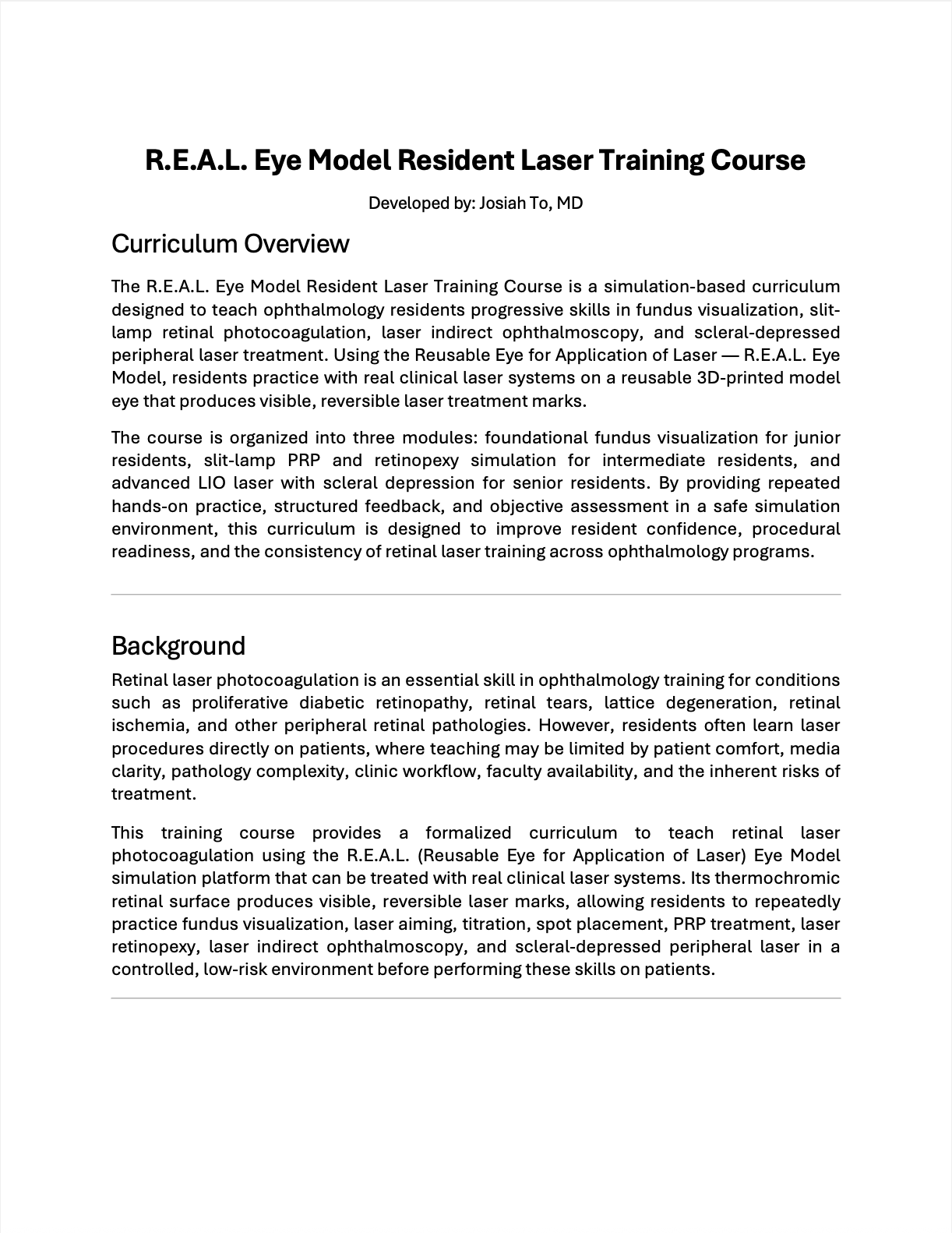
A structured R.E.A.L. Eye Model Resident Laser Training Course has been developed to teach retinal laser skills in a stepwise simulation format.
The curriculum includes three progressive modules:
Module 1: Fundus visualization
Module 2: Slit-lamp retinal laser photocoagulation
Module 3: Laser indirect ophthalmoscopy with scleral depression
Residents practice with real clinical laser systems on a reusable 3D-printed model eye that produces visible, reversible laser marks. The course is designed to build confidence, procedural readiness, and consistency in retinal laser training before patient care.
TRAINING CURRICULUM
FUTURE GOALS
1. Model Refinement
Future development may focus on improving optical realism, durability, modularity, and ease of manufacturing. Additional eye configurations could be created to simulate different refractive states, media clarity, or retinal pathology.
2. Educational Dissemination
The long-term goal is to make the R.E.A.L. Eye Model available as an accessible educational tool for ophthalmology residency programs, simulation centers, and global ophthalmology training environments.
PRESENTING THE WORK
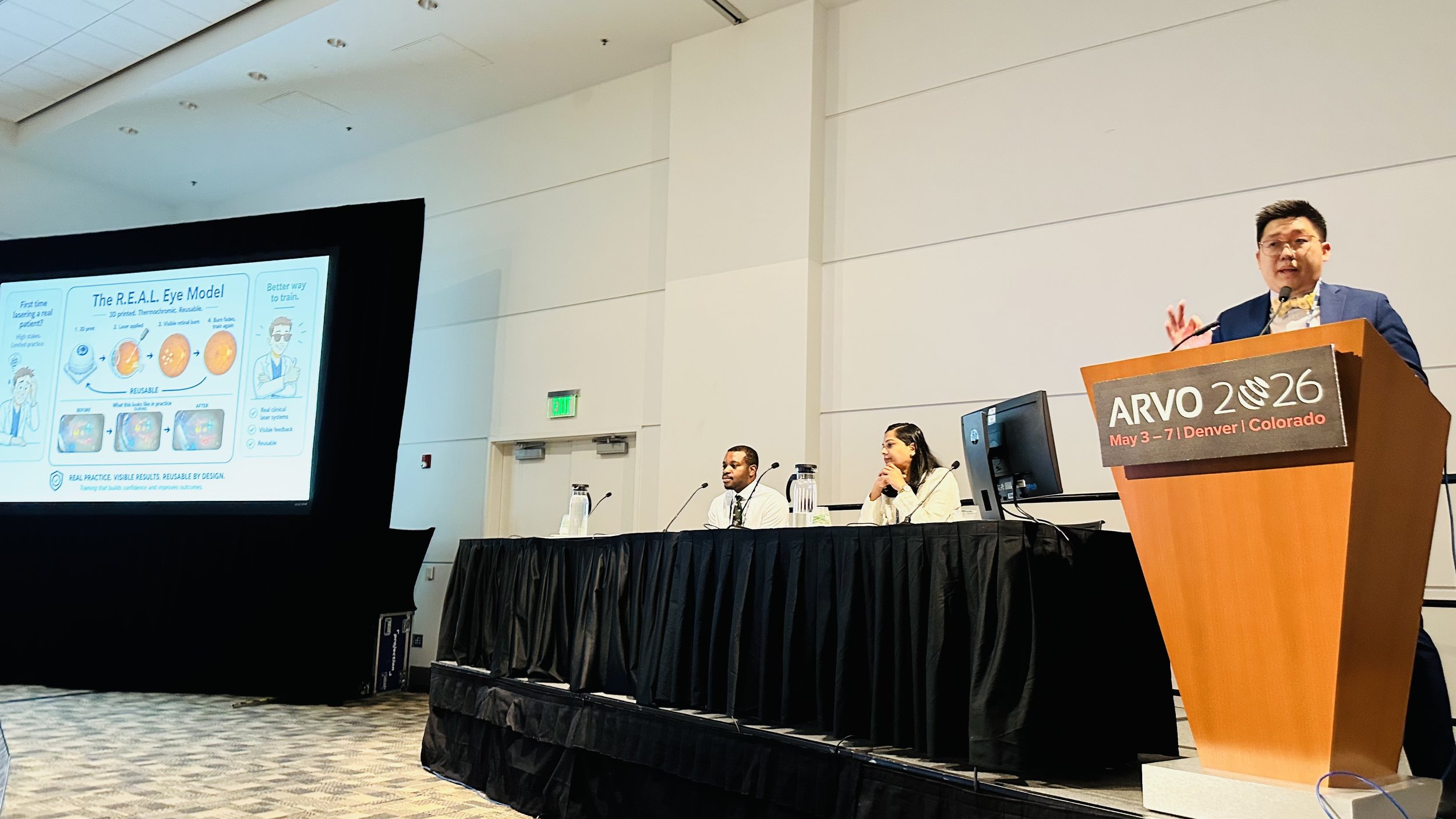
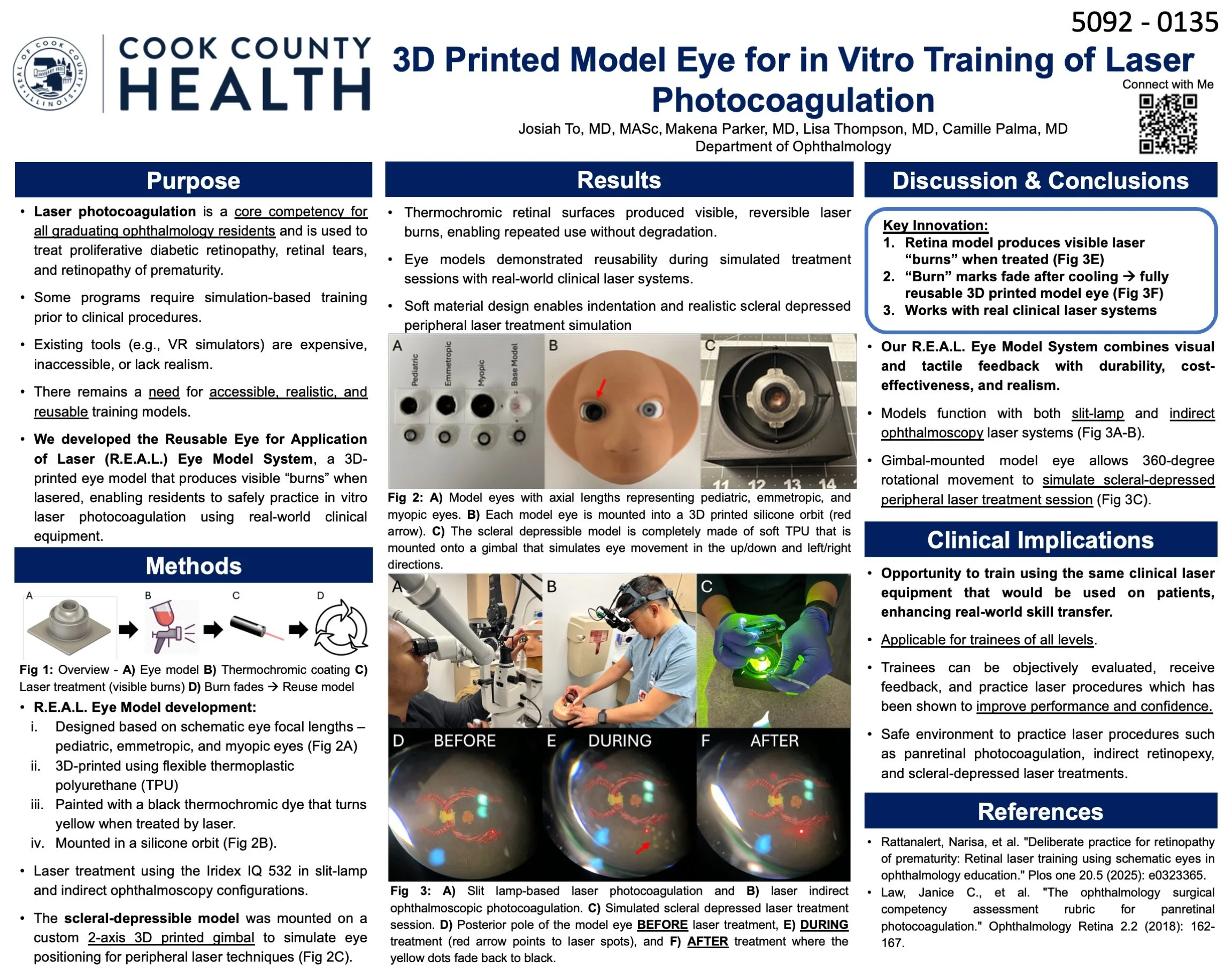
This project was presented at ARVO 2026 and selected as 1 of 16 winning projects in the Members-in-Training Poster Competition.
ARVO 2026 poster download